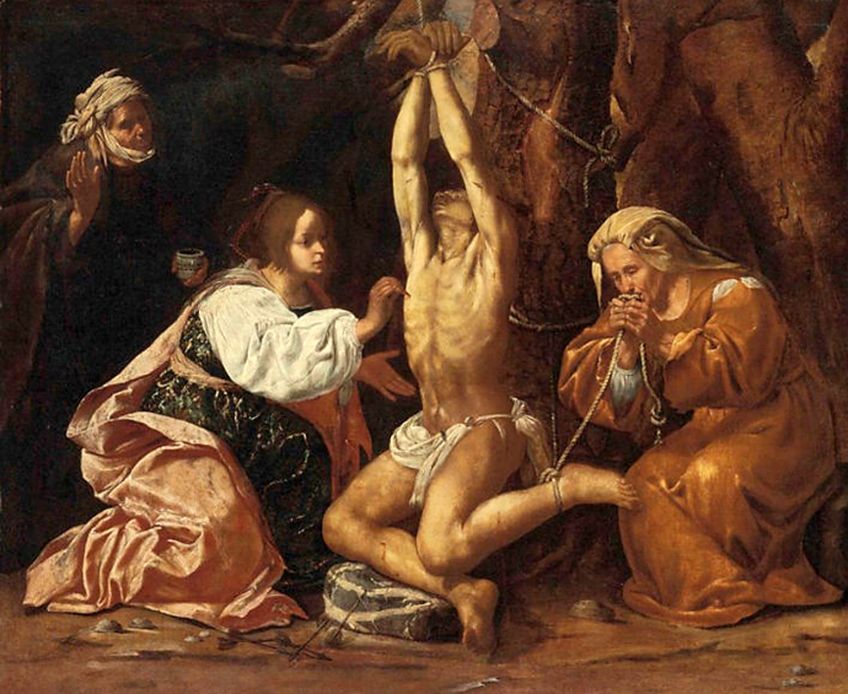
Regarding the unattributed seventeenth-century Neapolitan canvas (Oil on canvas, 105 x 126 cm.) depicting Saint Sebastian Attended by Saint Irene and the Holy Ladies, formerly as “Anonymous 17th-Century Neapolitan”), I am pleased to confirm that I have examined in person this painting, which I consider to be a significant and fully autograph work by the great Neapolitan master Aniello Falcone (Naples 1607 – 1656). In my opinion, this St. Sebastian by Falcone is datable to circa 1640 and is in very good condition (Fig. 1).
(Fig. 1) Aniello Falcone, Saint Sebastian Attended by Saint Irene and the Holy Ladies, c. 1640, Lauro Collection.
According to the Golden Legend, Sebastian was a Roman soldier, Captain of the Praetorian Guard, and martyr of the early Christian church. When the Emperor Diocletian discovered his Christianity, Sebastian was bound to a stake, pierced by arrows, and left for dead. A faithful woman, St. Irene, accompanied by her maids, found Sebastian still alive and tenderly nursed him back to recovery. The miraculous treatment of Sebastian was a popular subject across Europe, serving as a devotional image in times of the plague, and as a premier opportunity for artists to display their command of human anatomy.
In this remarkable composition by Aniello Falcone, the traditional religious scene is transformed into a tour de force demonstration of the commitment to naturalism and realistic anatomy for which Falcone is rightly celebrated. Caravaggesque in its style, the painter possesses an almost aggressive edge, seemingly willing to risk everything for a more penetrating tragic expression. The subject’s pathos is elevated by a fine pyramidal composition—balanced and compact—with the extraordinary central figure of the martyr forming the apex. The pyramid’s two diagonals rise from the backs of the holy women flanking the figure.
By 1640, the artist had absorbed the Roman taste for balance, equilibrium, and clarity, with the action positioned in the foreground as in ancient Roman reliefs. Falcone’s individuality is instantly discernible in this compositional strategy: all of the players in this tragedy are aligned in a tight row in the foreground plane. This exact relief-like staging directly mirrors the structural discipline he perfected during his major international history commissions for the Spanish Crown, most notably The Expulsion of the Moneychangers from the Temple (Prado Museum, Madrid) and the monumental Roman Athletes (Prado Museum, Madrid) (Fig. 2), both painted around 1638–1640.
Fig. 2. Aniello Falcone, Roman Athletes, Prado, 186 by 183 cm
Furthermore, the anatomical portrait of the bound Sebastian is firmly rooted in Falcone‘s characteristic drawing style. The short, thick proportions, compact lower torso, and blocky muscular evoke his secure red-chalk life studies, such as the Metropolitan Museum of Art’s Study of a Seated Nude Male (New York, Inv. 17.236.19).
Falcone’s celebrated The Concert (Museo di Capodimonte, Naples) confirms Falcone’s regular production of near-life-size, half-length horizontal cabinet pictures around the year of 1640. The cellist’s white sleeve—defined by sharp, geometric slashes of pure white paint emerging from deep shadow—reveals the identical shorthand seen on Saint Irene‘s garments. Additionally, the craggy, weathered popolano face of the singing old man on the far right of the Capodimonte canvas provides the exact physiognomic twin to the elderly maidservant holding the arrows in this Saint Sebastian, suggesting that they shared the same studio models.
This rediscovered Saint Sebastian Attended by Saint Irene and the Holy ladies is the only known version of this important and original composition and represents a major addition to the artist’s catalogue.
John T. SPIKE Virginia (Usa) 25 October 2026
Versione Italiana
In merito alla tela napoletana del XVII secolo, di autore ignoto (olio su tela, 105 x 126 cm), raffigurante *San Sebastiano soccorso da Sant’Irene e dalle pie donne* (già catalogata come “Anonimo napoletano del XVII secolo”), confermo di aver esaminato personalmente l’opera, che ritengo essere un lavoro significativo e pienamente autografo del grande maestro napoletano Aniello Falcone (Napoli 1607–1656).A mio avviso, questo *San Sebastiano* di Falcone è databile intorno al 1640 e si presenta in ottime condizioni di conservazione (Fig. 1). Secondo la *Legenda Aurea*, Sebastiano era un soldato romano, capitano della Guardia Pretoriana e martire della Chiesa paleocristiana.Quando l’imperatore Diocleziano scoprì la sua fede cristiana, Sebastiano fu legato a un palo, trafitto da frecce e lasciato per morto.Una donna devota, Sant’Irene, accompagnata dalle sue ancelle, ritrovò Sebastiano ancora in vita e lo curò amorevolmente fino alla guarigione.Il tema del soccorso miracoloso a San Sebastiano fu molto diffuso in tutta Europa, sia come immagine devozionale in tempi di peste, sia come occasione privilegiata per gli artisti di mostrare la propria maestria nella resa dell’anatomia umana. In questa straordinaria composizione di Aniello Falcone, la tradizionale scena religiosa si trasforma in un *tour de force* che testimonia quell’adesione al naturalismo e al realismo anatomico per cui l’artista è giustamente celebre.Di impronta caravaggesca, lo stile del pittore rivela una tensione quasi aggressiva, come se l’autore fosse disposto a tutto pur di raggiungere un’espressione tragica più profonda e penetrante.Il *pathos* del soggetto è esaltato da una raffinata struttura piramidale — equilibrata e compatta — che vede nella figura centrale del martire il proprio vertice.Le due diagonali della piramide si sviluppano a partire dalle schiene delle pie donne che fiancheggiano il protagonista. Intorno al 1640, l’artista aveva ormai assimilato il gusto romano per l’equilibrio, la proporzione e la chiarezza, disponendo l’azione in primo piano, secondo una modalità che richiama i rilievi dell’arte romana antica.L’individualità di Falcone è immediatamente riconoscibile in questa strategia compositiva: tutti i protagonisti della tragedia sono allineati in una fila serrata sul piano in primo piano.Questa messa in scena, che ricorda un bassorilievo, rispecchia fedelmente il rigore strutturale che l’artista perfezionò durante la realizzazione di importanti commissioni di soggetto storico per la Corona spagnola; tra queste spiccano *La cacciata dei mercanti dal Tempio* (Museo del Prado, Madrid) e i monumentali *Atleti romani* (Museo del Prado, Madrid) (Fig. 2), entrambi eseguiti intorno al 1638–1640. Inoltre, la resa anatomica di San Sebastiano, raffigurato legato, affonda le radici nel tipico stile grafico di Falcone.Le proporzioni tozze e robuste, il busto compatto e la muscolatura massiccia richiamano i suoi solidi studi dal vero a sanguigna, come lo *Studio di nudo maschile seduto* conservato al Metropolitan Museum of Art di New York (inv. 17.236.19). Il celebre *Concerto* di Falcone (Museo di Capodimonte, Napoli) conferma che, intorno al 1640, l’artista si dedicava regolarmente alla creazione di dipinti da collezione a sviluppo orizzontale, con figure a mezzo busto quasi a grandezza naturale. La manica bianca del violoncellista — definita da tratti netti e geometrici di colore bianco puro che emergono da un’ombra profonda — rivela la medesima cifra stilistica riscontrabile nelle vesti di Santa Irene.Inoltre, il volto rugoso e segnato dal tempo dell’anziano che canta, all’estrema destra della tela di Capodimonte, appare come il gemello fisiognomico dell’anziana serva che regge le frecce in questo *San Sebastiano*, il che suggerisce l’impiego dei medesimi modelli di bottega. Questo *San Sebastiano curato da Santa Irene e dalle pie donne*, recentemente riscoperto, costituisce l’unica versione nota di tale importante e originale composizione e rappresenta un’aggiunta di rilievo al catalogo dell’artista.
Utilizziamo i cookie sul nostro sito Web per offrirti l'esperienza più pertinente ricordando le tue preferenze e ripetendo le visite. Cliccando su "Accetta tutto", acconsenti all'uso di TUTTI i cookie. Tuttavia, puoi visitare "Impostazioni cookie" per fornire un consenso controllato.
This website uses cookies to improve your experience while you navigate through the website. Out of these, the cookies that are categorized as necessary are stored on your browser as they are essential for the working of basic functionalities of the website. We also use third-party cookies that help us analyze and understand how you use this website. These cookies will be stored in your browser only with your consent. You also have the option to opt-out of these cookies. But opting out of some of these cookies may affect your browsing experience.
Necessary cookies are absolutely essential for the website to function properly. These cookies ensure basic functionalities and security features of the website, anonymously.
Cookie
Durata
Descrizione
cookielawinfo-checkbox-analytics
11 months
This cookie is set by GDPR Cookie Consent plugin. The cookie is used to store the user consent for the cookies in the category "Analytics".
cookielawinfo-checkbox-functional
11 months
The cookie is set by GDPR cookie consent to record the user consent for the cookies in the category "Functional".
cookielawinfo-checkbox-necessary
11 months
This cookie is set by GDPR Cookie Consent plugin. The cookies is used to store the user consent for the cookies in the category "Necessary".
cookielawinfo-checkbox-others
11 months
This cookie is set by GDPR Cookie Consent plugin. The cookie is used to store the user consent for the cookies in the category "Other.
cookielawinfo-checkbox-performance
11 months
This cookie is set by GDPR Cookie Consent plugin. The cookie is used to store the user consent for the cookies in the category "Performance".
viewed_cookie_policy
11 months
The cookie is set by the GDPR Cookie Consent plugin and is used to store whether or not user has consented to the use of cookies. It does not store any personal data.
Functional cookies help to perform certain functionalities like sharing the content of the website on social media platforms, collect feedbacks, and other third-party features.
Performance cookies are used to understand and analyze the key performance indexes of the website which helps in delivering a better user experience for the visitors.
Analytical cookies are used to understand how visitors interact with the website. These cookies help provide information on metrics the number of visitors, bounce rate, traffic source, etc.
Advertisement cookies are used to provide visitors with relevant ads and marketing campaigns. These cookies track visitors across websites and collect information to provide customized ads.